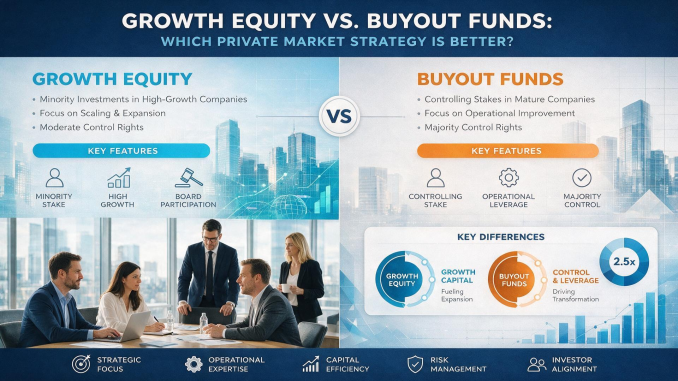
Two Strategies That Sit Between Venture and Traditional Buyouts
Private markets are often described as if there were only two categories: venture capital for young companies and buyouts for mature ones. That framing leaves out a large and increasingly important middle ground. Growth equity funds invest in companies that have already proven their product and built a customer base but still need capital to scale, expand into new markets, or strengthen their operations. Buyout funds acquire controlling stakes in mature companies, often using significant debt, and work to improve them before selling. Both sit within the private equity universe, but they behave very differently, and the question of which is better depends entirely on what the investor is trying to accomplish.
The distinction matters because the two strategies generate returns in different ways. Growth equity investment relies primarily on revenue growth. The fund buys a minority stake in a company that is expanding quickly, provides capital and guidance, and benefits when the company’s valuation rises as it scales. Buyout funds rely more heavily on operational improvement and financial engineering. They acquire control, often use leverage to amplify returns, improve margins, cut costs, or consolidate an industry, and then sell the company at a higher multiple or with stronger cash flows.
That difference in return drivers translates into different risk profiles. Growth equity is more exposed to the company’s ability to execute on its growth plan, and it can be vulnerable if the market slows or if the company’s expansion does not materialize as expected. Buyouts are more exposed to leverage and to the health of the credit markets, because the debt used to finance the acquisition has to be serviced regardless of how the company performs. A buyout that looks strong in a stable economy can come under pressure quickly if interest rates rise or if the company’s cash flows decline.
For families evaluating Private market investment strategies, the choice between growth equity and buyouts should be driven by a clear understanding of the underlying economics, the risk tolerance of the family, and the role each strategy plays in the broader portfolio. Neither is inherently better. They are different tools, and the right one depends on the job the family needs done.
How Each Strategy Actually Creates Value
Growth equity funds typically invest in companies that have reached a certain level of maturity. The company has a product that works, customers who pay for it, and a business model that has been validated. What it needs is capital to accelerate growth, whether that means hiring more salespeople, entering new geographies, building out infrastructure, or acquiring smaller competitors. The fund provides that capital in exchange for a minority stake, and it often takes a board seat or an observer role to help guide the company.
The value creation in growth equity comes from the company’s own growth. If the company grows revenue at a strong pace and improves its margins, its valuation will rise, and the fund’s stake will be worth more when the company is eventually sold or taken public. The fund’s role is to provide capital, strategic guidance, and introductions to customers and partners, but it does not typically run the company. That means the return depends heavily on the quality of the management team and the size of the market opportunity, which is why growth equity investors spend so much time evaluating founders and market dynamics.
Private equity buyout funds operate on a different model. They acquire a controlling stake in a mature company, often using a combination of equity and debt. The debt amplifies the return on equity, because the fund puts in less capital and captures the same upside. The fund then works to improve the company’s operations, which can mean cutting costs, professionalizing management, improving pricing, or pursuing add-on acquisitions to consolidate the industry. The goal is to increase the company’s cash flows and its valuation multiple, so that it can be sold for more than the fund paid.
The value creation in buyouts comes from a combination of operational improvement and financial engineering. The fund’s ability to improve the company is the primary driver, but the use of leverage and the ability to buy at a reasonable multiple also contribute. A buyout fund that pays too much for a company or that uses too much debt can struggle even if the underlying business is sound. That is why buyout funds tend to be very disciplined about entry price and about the amount of leverage they use. The best buyout funds have deep operational expertise and a clear playbook for improving the companies they acquire.

Risk, Return, and the Role of Leverage
The risk profiles of the two strategies differ in important ways. Growth equity funds typically use little or no leverage, which means the returns are driven primarily by the company’s growth rather than by financial engineering. That makes growth equity less exposed to credit market conditions, but it also means the returns depend more heavily on the company’s ability to execute. A growth equity investment in a company that fails to grow may produce a modest return or a loss, while a buyout investment in a company that struggles may produce a larger loss because of the debt burden.
Equity fund comparison often focuses on the return profiles of the two strategies, and the data shows that both can produce strong returns, but the dispersion within each category is wide. Top-quartile growth equity funds can generate returns comparable to top-quartile buyout funds, but the bottom-quartile funds in each category can underperform significantly. The difference between the best and worst performers in each category is one of the most important factors in manager selection, and it is more important than the choice between the two strategies themselves.
Leverage is the key differentiator in the risk profile. Buyout funds use debt to amplify returns, which means they can generate higher returns in a stable environment but are more vulnerable to a downturn. A buyout fund that uses five times leverage will see its equity wiped out if the company’s value falls by twenty percent, while a growth equity fund with no leverage will see a much smaller loss in the same scenario. That asymmetry is why buyout funds tend to be more sensitive to interest rates and credit conditions, and why they can experience sharp losses during a financial crisis.
Growth equity funds also carry risk, but the risk is different. The main risk is that the company’s growth slows or stops, which can happen if the market becomes saturated, if a competitor emerges, or if the management team fails to execute. Growth equity investments can also be vulnerable to valuation compression, because the companies they invest in often trade at high multiples of revenue or earnings. If the market’s appetite for growth companies declines, those multiples can fall, which reduces the value of the fund’s stake even if the company is still growing.
Which Strategy Fits Which Investor
The choice between growth equity and buyouts should be driven by the investor’s goals, risk tolerance, and time horizon. A family that is looking for exposure to fast-growing companies and is comfortable with the risk that comes with that growth may find growth equity attractive. A family that is looking for more stable returns and is comfortable with the operational and financial complexity of buyouts may find buyouts attractive. A family that wants both can allocate to both, with different weights depending on its overall portfolio and its appetite for risk.
The family’s existing exposure also matters. A family that already owns a mature operating business may find that growth equity is a better complement, because it provides exposure to a different stage of the business lifecycle. A family that has experience with leveraged transactions may find buyouts more comfortable, because the risk profile is familiar. A family with no experience in either category should start slowly, with a small allocation to a diversified fund, and build its knowledge before committing larger amounts.
The time horizon is another consideration. Growth equity investments often have a shorter time to exit than buyouts, because the companies are already growing and may be attractive acquisition targets or IPO candidates within a few years. Buyouts can take longer, because the fund needs time to improve the company’s operations before selling. A family that needs liquidity in the near term may prefer growth equity, while a family with a longer time horizon may be comfortable with buyouts.
The manager selection process is also different. Growth equity managers are often evaluated on their ability to identify fast-growing companies, their network in the startup and technology ecosystem, and their track record of backing successful founders. Buyout managers are often evaluated on their operational expertise, their ability to source and execute deals, and their track record of improving companies. The due diligence questions are different, and the family should use different criteria for each category. A manager who is excellent in one category is not necessarily excellent in the other, and the family should not assume that a strong track record in one translates to the other.
Common Mistakes and a Balanced Approach
The most common mistake is treating the two strategies as interchangeable. Families often assume that because they understand one, they understand the other, and they apply the same due diligence, the same allocation logic, and the same expectations. That assumption leads to disappointment, because the two strategies behave very differently. The fix is to recognize the differences and to build separate processes for each, with different criteria, different expectations, and different risk management.
Another common mistake is over-allocating to one strategy based on recent performance. Growth equity had a strong run through the 2010s, and many families increased their allocations as a result. That is a natural response, but it can lead to concentration and to disappointment when the cycle turns. The right approach is to set a target allocation based on the family’s goals and risk tolerance, and to rebalance toward that target rather than chasing performance.
A third mistake is underestimating the complexity of buyouts. Buyouts involve leverage, operational improvement, and complex legal structures, and they require more hands-on management than growth equity. A family that is not prepared for that complexity may find that its buyout investments underperform. The family should be realistic about the resources required and should work with advisors who have experience in the category.
Ultimately, growth equity and buyouts are both valuable tools for families that understand them and can afford the risks. The key is to approach them with discipline, to diversify across managers and vintages, to size allocations appropriately, and to maintain realistic expectations. Families that do this well tend to find that the two strategies complement each other, with growth equity providing exposure to fast-growing companies and buyouts providing stable, cash-generating businesses. Families that approach them casually often find that the lessons are expensive. The difference is in the preparation, and the preparation is worth the effort.