Two Ways to Own Art, and Two Very Different Experiences
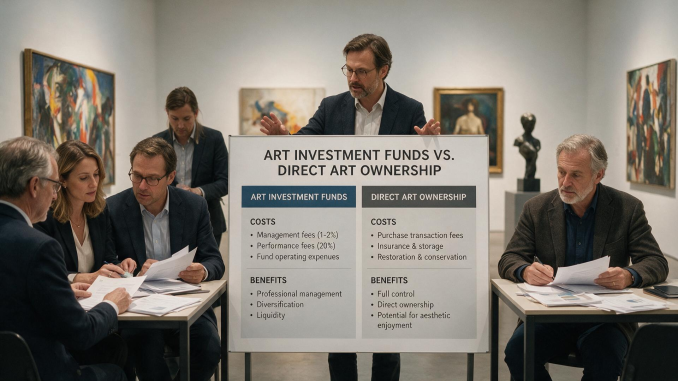
Wealthy families have been collecting art for centuries, but the way they own it has changed significantly over the past two decades. Traditionally, a family bought a painting, hung it on the wall, and held it for decades. That model still exists, and for many families it remains the right one. But a parallel model has emerged: art investment funds that pool capital from multiple investors, acquire a portfolio of works, and manage them professionally with the goal of generating a financial return. The two approaches are not simply different wrappers around the same asset. They involve different costs, different risks, different levels of control, and different relationships with the art itself. Understanding those differences is essential before a family decides which path to take.
The direct ownership model is intuitive. The family buys a work, pays for it, insures it, displays it, and eventually sells it or passes it to the next generation. The family controls every decision, from which work to buy to when to sell. The family also enjoys the aesthetic and social benefits of ownership, which can be substantial. But the model requires expertise, time, and capital. The family needs to understand the market, evaluate authenticity and provenance, negotiate with dealers, manage insurance and storage, and plan for resale. Those tasks are demanding, and they are not always compatible with the family’s other priorities.
The fund model is different. The family invests capital in a fund, and the fund’s managers make the decisions about which works to buy and sell. The family does not own the individual works, and it does not have the same aesthetic or social benefits. But the family also does not have the same operational burden, because the fund handles the sourcing, the due diligence, the storage, and the resale. The fund model provides diversification, professional management, and access to works that an individual family might not be able to source on its own. It also provides liquidity, in the sense that the family can sell its fund interest, although the liquidity is limited and the market for fund interests is thin. Art investment funds are a legitimate option, but they are not a simple substitute for direct ownership.
How Art Investment Funds Actually Work
An art investment fund is a pooled vehicle that raises capital from multiple investors and uses it to acquire a portfolio of artworks. The fund is typically structured as a limited partnership or an LLC, and it is managed by a general partner or a management company that has expertise in the art market. The fund’s investment thesis may focus on a particular segment of the market, such as blue-chip contemporary art, Old Masters, or emerging artists, or it may be diversified across multiple segments. The fund’s managers make the acquisition and disposition decisions, and the investors receive a share of the returns after fees and expenses.
The fund’s structure has several implications. The first is that the investors do not own the individual works, so they do not have the ability to display them, to lend them to museums, or to enjoy them personally. The second is that the investors do not control the acquisition or disposition decisions, so they are dependent on the managers’ judgment. The third is that the investors are subject to the fund’s fee structure, which typically includes a management fee and a performance fee. The fourth is that the investors are subject to the fund’s liquidity terms, which may include a lock-up period and restrictions on withdrawals.
The fund’s managers are the key to its success. A good manager has deep expertise in the art market, strong relationships with dealers and collectors, and a track record of successful acquisitions and dispositions. A poor manager may overpay for works, fail to sell them at the right time, or make other mistakes that erode returns. The investors should evaluate the managers with the same rigor they would apply to any other investment, including their experience, their track record, their network, and their alignment of interests. Art funds for investors are only as good as the people running them, and the due diligence should focus on those people.
The fund’s fee structure is another important consideration. A typical art fund charges a management fee of one to two percent and a performance fee of twenty percent, often with a hurdle rate. Those fees can be significant, and they reduce the net return to investors. The investors should understand exactly what they are paying for, and they should compare the fees to industry norms. A fund that charges above-market fees needs to justify them with above-market performance, and the investors should be skeptical of a fund that is unwilling to discuss fees openly.
The Costs and Benefits of Direct Ownership
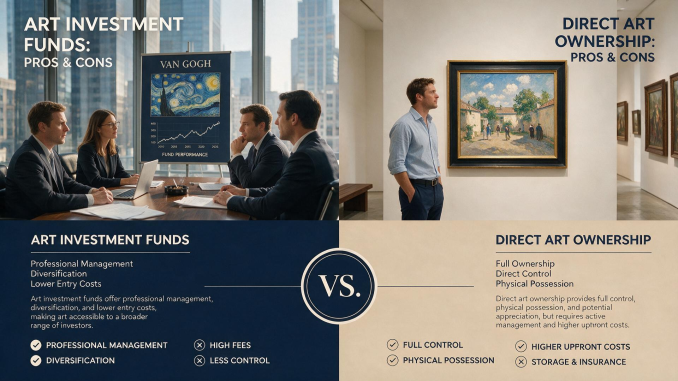
Direct ownership has its own costs and benefits, and they are different from those of the fund model. The benefits are significant. The family controls every decision, which means it can buy what it loves, hold for as long as it wants, and sell when the timing is right. The family enjoys the aesthetic and social benefits of ownership, which can be substantial. The family can lend works to museums, which can enhance the works’ provenance and value. The family can pass works to the next generation, which can be a meaningful legacy. And the family can use the works as part of its estate plan, potentially reducing estate tax through charitable donations or other strategies.
The costs are equally significant. Direct ownership requires expertise, and a family that does not have that expertise may make expensive mistakes. The family needs to evaluate authenticity and provenance, negotiate with dealers, manage insurance and storage, and plan for resale. Those tasks take time and attention, and they may require the family to hire advisors. The family also bears the full risk of ownership, including the risk of damage, theft, or a decline in the artist’s market. And the family’s capital is tied up in a single work or a small number of works, which means the family is exposed to concentration risk. Direct art ownership is not a passive investment. It is a commitment that requires ongoing attention.
The transaction costs of direct ownership are also significant. The buyer’s premium at auction can be twenty percent or more, and the seller’s commission can be ten percent or more. Those costs reduce the return on the investment, and they should be factored into the purchase decision. The family should also consider the costs of insurance, storage, conservation, and estate planning, which can add up to a significant percentage of the collection’s value each year. A collection that looks affordable on paper may be a financial drain in practice, especially if the family does not have the resources to maintain it properly.
The liquidity of direct ownership is limited. A work of art can take months or years to sell, and the process is not always predictable. The family should be prepared to hold the work for a long time, and it should not rely on the art to provide liquidity in a crisis. The family should also consider the tax consequences of a sale, because the gain may be subject to capital gains tax, and the family may be able to offset the gain with charitable donations or other strategies.
Diversification, Management, and the Role of Advisors
The fund model offers diversification that direct ownership typically does not. A fund may hold dozens of works by multiple artists, which spreads the risk across the portfolio. A family that owns a single work is exposed to the performance of that work and that artist, which is a concentrated bet. The diversification benefit is one of the main reasons families choose the fund model, especially if they do not have the expertise to build a diversified collection on their own.
The fund model also offers professional management, which can be valuable for families that do not have the time or the expertise to manage a collection. The fund’s managers handle the sourcing, the due diligence, the storage, and the resale, which frees the family to focus on other priorities. The managers also have relationships with dealers and collectors that can provide access to works that the family might not be able to source on its own. Those relationships can be a significant advantage, especially in a market where access is often more important than capital. Art investment management is a specialized skill, and the fund model allows families to access that skill without building an in-house team.
The direct ownership model can also benefit from advisors, but the relationship is different. The family hires advisors to help with specific tasks, such as sourcing, authentication, or valuation, but the family retains control. That control can be valuable, because the family can make decisions that are aligned with its goals rather than with the advisor’s incentives. The family should choose its advisors carefully, and it should work with people who have expertise in the specific segment of the market it is targeting.
The choice between the two models depends on the family’s goals, its resources, and its preferences. A family that wants to enjoy the art, to control the collection, and to build a legacy may prefer direct ownership. A family that wants diversification, professional management, and a more passive investment may prefer the fund model. A family that wants both can use both, with direct ownership for the works it loves and fund investments for the financial exposure. Fine art portfolio diversification can be achieved through either model, but the approach is different.
Common Mistakes and the Long View
The most common mistake with art funds is choosing the wrong manager. A fund is only as good as the people running it, and a manager who lacks expertise or alignment can destroy value. The investors should evaluate the managers with the same rigor they would apply to any other investment, including their experience, their track record, their network, and their fees. They should also consider the fund’s liquidity terms, its fee structure, and its investment thesis before committing capital.
The most common mistake with direct ownership is buying on emotion. A family that falls in love with a work may overlook its flaws, overpay for it, and fail to consider its resale potential. The result can be a collection that is a source of pleasure but not a source of wealth. The family should approach the purchase with discipline, and it should be prepared to walk away if the work does not meet its criteria.
Another common mistake is ignoring the costs of ownership. Whether the family chooses a fund or direct ownership, the costs of insurance, storage, conservation, and management can be significant. The family should budget for those costs, and it should factor them into the investment analysis. A collection that looks affordable on paper may be a financial drain in practice, especially if the family does not have the resources to maintain it properly.
Ultimately, the choice between art funds and direct ownership is not about which one is better. It is about which one fits the family’s goals, resources, and preferences. Both models can be valuable, and both can be risky. The families that do well are the ones that understand the differences, that choose the model that fits their circumstances, and that manage the investment with discipline. Those families tend to find that art is both a source of joy and a source of wealth, and that the two are not in conflict. The families that approach it casually often find that the costs outweigh the benefits. The difference is in the approach, and the approach is what makes the investment work.