Two Structures, One Goal: Serving the Family Well
When a family reaches a certain level of wealth, the question of how to organize its financial affairs becomes unavoidable. The patchwork of advisors that worked when the balance sheet was smaller and the family was simpler starts to feel inadequate. Documents get lost, advisors work at cross purposes, decisions take too long, and no one has a complete picture of what the family actually owns. That is the moment when the family starts thinking about a family office, and the first question it faces is whether to build a dedicated organization for itself or to join a shared platform that serves multiple families. The two models are often presented as a status choice, with the single-family office framed as the ultimate expression of wealth. That framing is unhelpful. The right question is which structure fits the family’s complexity, its budget, its need for control, and its long-term goals.
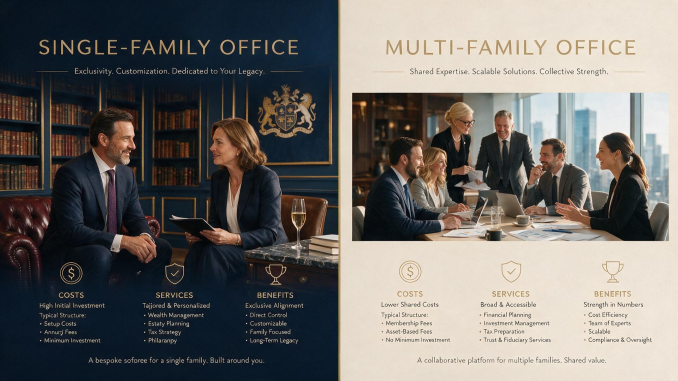
The single-family office is a dedicated organization that serves one family. It employs its own team, maintains its own systems, and operates according to the family’s priorities. That gives the family complete control over the office’s agenda, its staffing, its investment approach, and its reporting. The office can be tailored to the family’s specific needs, whether that means a heavy focus on private markets, an emphasis on philanthropic coordination, or deep support for the next generation’s education. The family also has direct access to the people managing its affairs, without having to navigate a large institution’s hierarchy.
The multi-family office is a shared platform that serves several families. It pools the costs of staff, systems, and infrastructure across its client base, which allows it to offer a broad range of services at a lower cost per family. The multi-family office typically has a standardized investment process, a professional reporting platform, and a team of specialists who work across clients. The family benefits from the office’s experience with other families, its access to institutional-quality managers, and its ability to scale services as the family’s needs change. The trade-off is that the family has less control over the office’s priorities, and it may receive less customization than a single-family office would provide.
The choice between the two models is not about which one is better in the abstract. It is about which one fits the family’s circumstances. A family with a billion dollars, a global business, and complex governance needs is likely to benefit from the control and customization of a single-family office. A family with a hundred million dollars and a diversified portfolio is likely to find that a multi-family office provides better value and access to services that would be too expensive to build in-house. Single family office vs multi family office is a decision that should be driven by the family’s specific needs, not by a desire to match the choices of peers.
The Real Cost of Running a Single-Family Office
The cost of a single-family office is the factor that most often determines whether the model is viable. A dedicated office requires a team, and a team requires salaries, benefits, and office space. It requires technology systems for portfolio management, reporting, accounting, and document management. It requires legal, tax, and compliance support, either in-house or through external advisors. And it requires a governance structure, including an investment committee, a family council, and a process for making decisions. Those costs add up quickly, and they are largely fixed, which means they do not scale down when the family’s assets decline.
A typical single-family office might cost between one and three million dollars a year to operate, depending on the size of the team and the scope of services. For a family with five hundred million dollars, that represents somewhere between twenty and sixty basis points, which is manageable. For a family with a hundred million dollars, the same cost represents one to three percent of assets, which is difficult to justify unless the family’s needs are unusually complex. That is why most advisors recommend that a single-family office be considered only for families with several hundred million dollars or more, unless there are specific circumstances that justify the cost.
The cost structure of a single-family office also creates a potential conflict. The office’s expenses are borne by the family, regardless of whether the family is satisfied with the service. That can create pressure to justify the expense by adding services or by taking on more active investment strategies, which may not always be in the family’s best interest. The family should be clear about what it wants the office to do, and it should hold the office accountable to measurable outcomes rather than to activity. Family office costs should be evaluated against the value the office provides, not against the size of the office’s budget.
The family should also consider the indirect costs. A single-family office requires the family to spend time recruiting, managing, and retaining a team, which can be a significant burden. It also requires the family to make decisions about the office’s structure and strategy, which can be time-consuming and divisive. Those costs are not captured in the office’s budget, but they are real, and they should be part of the decision. A family that does not have the time or the inclination to manage an office may find that the multi-family model is a better fit.
The Benefits and Trade-Offs of a Multi-Family Office
The multi-family office offers several advantages that make it attractive to families that do not have the resources or the desire to build a dedicated office. The first is cost. By sharing the costs of staff, systems, and infrastructure across multiple families, the multi-family office can offer a broad range of services at a lower cost per family. That cost advantage is particularly important for families with fifty to several hundred million dollars, where the cost of a single-family office would be prohibitive but the need for professional management is real.
The second advantage is access. A multi-family office typically has relationships with institutional managers, private equity funds, and other investment opportunities that an individual family might not be able to access on its own. Those relationships can provide access to better terms, better managers, and better opportunities, which can improve the family’s returns. The multi-family office also has the scale to conduct due diligence on those opportunities, which is a service that an individual family might not be able to replicate.
The third advantage is expertise. A multi-family office employs specialists in investments, tax, estate planning, and philanthropy, and it can bring that expertise to bear on the family’s specific needs. The family does not have to hire those specialists itself, which reduces both the cost and the management burden. The multi-family office also has experience with other families, which can provide valuable perspective on the family’s own challenges. Multi family office services are designed to provide comprehensive support without the overhead of a dedicated organization.
The trade-offs of the multi-family model are also real. The family has less control over the office’s priorities and may receive less customization than a single-family office would provide. The office’s investment process may be standardized, which means the family may not be able to pursue a strategy that is unique to its needs. The office’s fees may be lower than a single-family office’s, but they are still significant, and the family should understand exactly what it is paying for. The family should also consider the office’s ownership and its incentives, because those factors affect the quality of the service and the alignment of interests.
Which Model Fits Which Family
The choice between a single-family office and a multi-family office depends on several factors, and the family should evaluate each of them before making a decision. The first factor is the size of the family’s wealth. A family with several hundred million dollars or more can justify the cost of a single-family office, while a family with less may find that the multi-family model provides better value. The second factor is complexity. A family with a business, multiple properties, trusts, philanthropic interests, and members in different jurisdictions is likely to need the customization and control that a single-family office provides, while a family with a simpler balance sheet may find that the multi-family model is sufficient.
The third factor is the family’s need for control. A family that wants to direct its own investment strategy, set its own priorities, and manage its own team is likely to prefer the single-family model. A family that is comfortable delegating those decisions to a professional team is likely to prefer the multi-family model. The fourth factor is the family’s willingness to manage a team. A single-family office requires the family to recruit, manage, and retain professionals, which is a significant commitment. A family that does not want that responsibility should consider the multi-family model. Private family wealth management should be structured around the family’s actual capacity to oversee the office, not around an aspiration to operate like a large institution.
The fifth factor is the family’s stage of life. A family that is preparing for a generational transition may need more education and governance support, which a single-family office can provide. A family that is focused on investment management may find that a multi-family office provides the expertise and access it needs. A family that is planning a liquidity event may need help with the transaction, which either model can provide, but the single-family office may be able to provide more customized support.
The family should also consider a hybrid approach. Some families start with a multi-family office and later transition to a single-family office as their wealth grows and their needs become more complex. Others maintain a small single-family office for coordination and governance while outsourcing investment management to external managers. The hybrid approach can provide the best of both models, but it requires careful design and a clear understanding of who is responsible for what. Family office management is not a binary choice. It is a spectrum of options, and the family should choose the option that fits its specific circumstances.
Common Mistakes and the Long View
The most common mistake is choosing a model based on prestige rather than fit. A family that hires a famous multi-family office may find that it is paying for services it does not need, while a family that builds a single-family office may find that the cost is not justified by the value it receives. The family should focus on its specific needs and should choose the model that fits those needs, regardless of what peers are doing.
Another common mistake is underestimating the cost of a single-family office. The direct costs are significant, and the indirect costs, including the family’s time and attention, are often overlooked. The family should build a detailed budget and should be realistic about what it can afford. A single-family office that is underfunded will struggle to provide the level of service the family expects, which can lead to frustration and turnover.
A third mistake is failing to define the office’s mandate. A family office without a clear mandate can drift, taking on activities that are not aligned with the family’s goals or that duplicate the work of external advisors. The family should define the office’s responsibilities in writing and should review the mandate regularly as circumstances change.
Ultimately, the choice between a single-family office and a multi-family office is about finding the structure that best serves the family’s needs. Both models can work well, and both can fail if they are not designed and managed properly. The families that do well are the ones that understand their own needs, that evaluate the options carefully, and that build a structure that is aligned with their goals. Those families tend to find that the office is a valuable partner in preserving and growing their wealth, rather than a source of cost and complexity. The difference is in the design, and the design is what makes the model work.