
Why the Cost Question Is Harder to Answer Than It Looks
Ask five families what it costs to run a family office and you will get five very different answers. One will say a few hundred thousand dollars a year, another will say several million, and a third will say it depends on what you count. The variation is not because one family is wrong and another is right. It is because the term family office covers an enormous range of organizations, from a single professional coordinating advisors part-time to an institution with dozens of employees, proprietary technology, and a global investment program. The cost of the first is measured in tens of thousands of dollars, and the cost of the second is measured in millions. Any honest discussion of family office costs has to start with that range.
The second reason the question is hard to answer is that the direct costs are only part of the picture. A family office also consumes the family’s time, requires governance, and creates obligations that are not captured in a budget. The family has to recruit and manage a team, review performance, and make decisions about strategy. Those activities have an opportunity cost, and they can be substantial, especially for families that do not have experience managing an organization. The indirect costs are easy to overlook, but they are real, and they should be part of the calculation.
The third reason is that the cost of a family office is not fixed. It depends on the scope of services, the size of the team, the complexity of the family’s affairs, and the technology the office uses. A family that wants a comprehensive office with investment management, tax planning, legal coordination, philanthropic services, and next-generation education will pay significantly more than a family that wants a lean office focused on coordination and reporting. The family should define what it wants before it estimates the cost, because the scope drives the budget more than any other factor.
The fourth reason is that the cost should be evaluated against the value. A family office that costs two million dollars a year but saves the family five million dollars in taxes, fees, and mistakes is a good investment. A family office that costs one million dollars a year but provides little value is expensive at any price. The family should think about the cost in the context of the benefits, not in isolation. Family office setup cost is a meaningful question, but it is only one part of the analysis.
The Setup Costs: What It Takes to Get Started
The setup costs of a family office fall into several categories, and they can range from modest to substantial depending on the model. The first category is legal and structural. A single-family office typically requires a legal entity, an operating agreement, and a governance structure. The family may also need to create or restructure trusts, holding companies, and other entities to hold its assets. The legal work can cost anywhere from tens of thousands to several hundred thousand dollars, depending on the complexity of the family’s affairs and the jurisdiction.
The second category is technology. A family office needs systems for portfolio management, accounting, reporting, document management, and cybersecurity. The cost of those systems can range from a few thousand dollars a year for cloud-based tools to several hundred thousand dollars for a custom platform. The family should choose systems that fit its needs and its budget, and it should avoid overbuilding technology that it will not use. A lean office can operate effectively with cloud-based tools, while a large office may need a more sophisticated platform.
The third category is staffing. The family office needs a team, and the team needs to be recruited. The cost of recruiting depends on the seniority of the roles and the market for talent. A chief investment officer, a chief financial officer, and a tax specialist are expensive to recruit, and the process can take months. The family should budget for recruitment costs, including search fees, relocation, and signing bonuses, and it should be prepared for the time it takes to build a team. Private family office services can be a useful alternative for families that want to avoid the cost and complexity of building a team from scratch.
The fourth category is office space and infrastructure. A family office needs a physical location, furniture, equipment, and utilities. The cost depends on the location, the size of the office, and the number of employees. A small office in a secondary market may cost a few thousand dollars a month, while a large office in a major city may cost significantly more. The family should consider whether it needs a physical office at all, because a virtual office can reduce costs and provide flexibility.
The Ongoing Operating Costs: Salaries, Systems, and Services
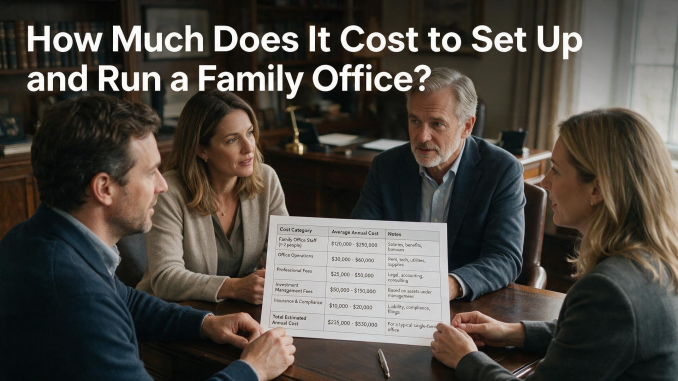
The ongoing operating costs of a family office are the largest part of the budget, and they are driven primarily by salaries. A single-family office typically employs a team that includes a chief investment officer, a chief financial officer, an accountant, an operations professional, and administrative staff. The salaries for those roles vary by market and by experience, but a team of five to ten professionals can easily cost between one and three million dollars a year, including benefits and bonuses. A larger office with a deeper team can cost significantly more.
The second major cost is investment management. A family office may employ its own investment professionals, or it may outsource investment management to external managers. The cost of in-house management includes salaries, research, and technology, while the cost of external management includes management fees and performance fees. The family should compare the two approaches and should choose the one that provides the best value. A family with a large portfolio may find that in-house management is more cost-effective, while a family with a smaller portfolio may find that external managers provide better access and expertise. Family office operating expenses should be reviewed annually to ensure that the office is operating efficiently.
The third major cost is professional services. A family office typically works with external attorneys, accountants, and consultants, and those services can add up to a significant amount. The family should budget for legal fees, tax preparation, audit fees, and consulting fees, and it should review those costs regularly to ensure that they are reasonable. A family office that relies too heavily on external advisors may find that the cost of those services exceeds the cost of building in-house expertise.
The fourth major cost is technology and administration. A family office needs ongoing investment in technology, including software licenses, cybersecurity, and data management. It also needs administrative support, including office management, travel, and insurance. Those costs can add up to several hundred thousand dollars a year, depending on the size of the office and the scope of its activities. Family office administration is often underestimated, but it is a significant part of the budget.
The Multi-Family Office Alternative and Its Fee Structure
For families that do not want to bear the full cost of a single-family office, the multi-family office provides an alternative. A multi-family office pools the costs of staff, systems, and infrastructure across multiple families, which allows it to offer services at a lower cost per family. The fee structure varies, but most multi-family offices charge a percentage of assets under management, often in the range of half a percent to one percent, plus additional fees for specialized services.
The multi-family office model can be more cost-effective for families with less than several hundred million dollars, because the cost of a single-family office would be prohibitive. The family gets access to a professional team, institutional-quality investment opportunities, and a reporting platform without having to build those capabilities itself. The trade-off is that the family has less control over the office’s priorities and may receive less customization than a single-family office would provide.
The family should compare the cost of a multi-family office to the cost of a single-family office on a like-for-like basis. A multi-family office that charges one percent of assets on a hundred million dollar portfolio costs one million dollars a year, which may be comparable to the cost of a lean single-family office. A multi-family office that charges half a percent on a five hundred million dollar portfolio costs two and a half million dollars a year, which may be more than the cost of a single-family office with a similar scope. The comparison should be based on the services provided, not just the headline fee. Family office management fees should be evaluated in the context of the value the family receives.
The family should also consider the virtual family office model, which coordinates external advisors rather than employing an in-house team. The virtual model can be the most cost-effective option for families that want coordination without the overhead of a full-time team. The cost depends on the scope of the engagement and the fees charged by the external advisors, but it is typically lower than the cost of a single-family office or a multi-family office. The trade-off is that the virtual model depends heavily on the lead advisor’s ability to coordinate and on the quality of the external providers.
Common Mistakes and the Long View
The most common mistake is underestimating the cost. Families often budget for salaries and technology but overlook the indirect costs, including recruitment, training, turnover, and the family’s time. The result is a budget that looks reasonable on paper but is exceeded in practice. The family should build a detailed budget that includes all of the costs, and it should add a contingency for unexpected expenses.
Another common mistake is overbuilding. A family that builds a large office before it has the assets or the complexity to justify it may find that the cost exceeds the value. The family should start lean and scale up as its needs grow, rather than building a large organization in anticipation of future needs. A lean office can always add staff and services, but a large office that is not justified by the family’s needs is difficult to scale down.
A third mistake is failing to measure value. A family office that does not track its performance against clear metrics cannot demonstrate its value to the family, which can lead to questions about whether the office is worth the cost. The family should define the metrics that matter, including investment performance, tax savings, cost savings, and service quality, and it should review those metrics regularly. Family office setup cost is only the beginning. The ongoing cost and the value delivered are what determine whether the office is a good investment.
Ultimately, the cost of a family office depends on the family’s needs, its complexity, and the model it chooses. A lean virtual office can cost a few hundred thousand dollars a year, while a full-service single-family office can cost several million. The right choice depends on the family’s circumstances, and the family should approach the decision with a clear understanding of what it wants the office to do and what it is willing to pay. Those families that get the balance right find that the office is a valuable partner in preserving and growing their wealth, rather than a source of cost and complexity. The difference is in the design, and the design is what makes the model work.