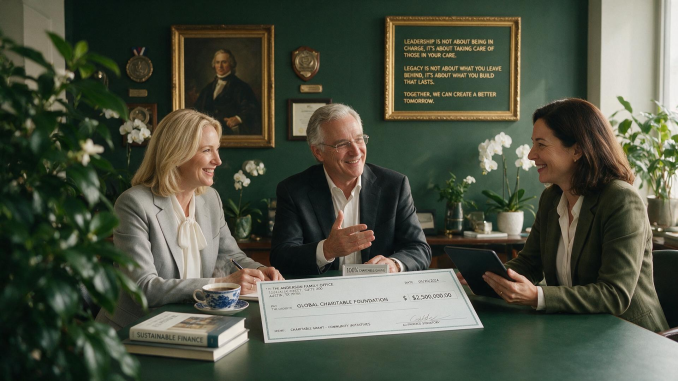
Why Philanthropy Belongs in the Family Office Conversation
Philanthropy is often treated as a separate activity from wealth management. The family makes charitable gifts, the family office handles the paperwork, and the two functions operate in parallel without much interaction. That separation is a missed opportunity. Philanthropy is one of the most powerful tools a family has for achieving its financial goals, for engaging the next generation, and for transmitting values across generations. The families that integrate philanthropy into their family office strategy tend to give more effectively, save more on taxes, and have stronger relationships among their members.
The financial case for integration is straightforward. Charitable giving can reduce income tax, reduce estate tax, and reduce capital gains tax, depending on how the gift is structured and what assets are used. A family that gives appreciated securities rather than cash can avoid the capital gain while still taking the deduction. A family that uses a charitable remainder trust can convert a concentrated position into an income stream while supporting a cause. A family that uses a private foundation can control its giving over time and involve the next generation in the process. Those strategies require coordination between the family office, the tax advisor, and the philanthropic advisor, and that coordination is what Family office philanthropy is designed to provide.
The human case is equally compelling. Philanthropy gives family members a shared project that is not about money but about purpose. It gives the next generation an opportunity to learn about wealth, about decision-making, and about the responsibilities that come with privilege. It gives the family a way to talk about its values and to pass them on to future generations. And it gives the family a way to connect with the broader community and to build a legacy that is about more than financial success. Those benefits are difficult to quantify, but they are real, and they are often the reason families continue to give even when the tax benefits are modest.
The final reason philanthropy belongs in the family office conversation is that it is a significant part of the family’s wealth. A family that has committed to giving a portion of its wealth to charity has made a decision about how its assets will be used, and that decision should be integrated with the family’s broader financial plan. The family office should understand the family’s philanthropic goals, should help structure the giving in a tax-efficient way, and should ensure that the giving is consistent with the family’s values and its other objectives. Charitable wealth planning is not an afterthought. It is an integral part of the family’s financial strategy.
The Main Vehicles and How They Differ
There are several vehicles that a family can use for its philanthropy, and each has its own advantages and disadvantages. The simplest is direct giving, which involves making gifts to charities as the family chooses. Direct giving is flexible and requires no administrative structure, but it offers limited tax benefits and no opportunity for family involvement over time. It is best suited for families that give modest amounts and that do not want the complexity of a formal structure.
A donor-advised fund is the next step up. A DAF is a charitable account that is sponsored by a public charity, and the donor can recommend grants from the account over time. The donor receives an immediate tax deduction when the account is funded, and the assets in the account can be invested and grow tax-free. DAFs are easy to establish, have low administrative costs, and offer flexibility in the timing of grants. They are particularly well suited for families that want to give regularly but do not want the complexity of a private foundation. Private family foundations are a more elaborate alternative, and the choice between the two depends on the family’s goals and its resources.
A private foundation is a separate legal entity that is created and funded by the family. It has its own board, its own staff, and its own grant-making program. The foundation is subject to more complex rules than a DAF, including minimum distribution requirements, excise taxes, and reporting obligations. But it also offers more control over the giving, more opportunities for family involvement, and a more lasting legacy. A private foundation is best suited for families that are committed to a long-term philanthropic program and that have the resources to support the administrative burden.
A charitable remainder trust is a different type of vehicle. It allows the donor to contribute appreciated assets, receive an income stream for a term or for life, and leave the remainder to charity. The trust can sell the assets without immediate tax, which allows it to diversify without triggering a large gain. A charitable lead trust works in the opposite direction, paying income to charity for a term and then passing the remainder to heirs. Both structures can be powerful tools for Philanthropic investment strategies, but they require careful planning and are best suited for families with significant assets and a clear charitable intent.

Involving the Next Generation in Philanthropy
One of the most valuable things a family can do with its philanthropy is to use it as a tool for engaging the next generation. A family that gives together, decides together, and learns together is a family that is more likely to stay together. The philanthropy gives the next generation a role, a voice, and a sense of purpose. It teaches them about decision-making, about the needs of the community, and about the responsibilities that come with wealth. And it gives them an opportunity to work with their parents and grandparents in a context that is not about money but about values.
The involvement should start early. Younger family members can be included in discussions about the family’s giving, can be asked for their opinions on which causes to support, and can be given small amounts of money to give as they choose. As they get older, they can take on more responsibility, including serving on the foundation’s board, evaluating grant requests, and leading site visits. The goal is to give them a gradual introduction to philanthropy, so that they can develop their own philanthropic interests and skills over time.
The involvement should also be structured. A family that wants the next generation to take on a meaningful role should create a formal process for doing so, including education, mentorship, and a clear path to leadership. The process should be transparent and should be communicated to all family members, so that everyone understands how decisions are made and who is responsible for what. That structure is particularly important for families with a private foundation, where the governance and the succession of the board are critical to the foundation’s long-term success.
The involvement should also be flexible. Different family members will have different interests and different levels of commitment, and the family should respect those differences. Some may want to be deeply involved in the foundation, while others may prefer to support the family’s giving in other ways. The family should create multiple ways to participate, so that everyone can find a role that fits their interests and their skills. Family charitable giving is most effective when it is aligned with the family’s values and when all members feel that they have a meaningful role.
Measuring Impact and Making Giving More Effective
Philanthropy is not just about writing checks. It is about making a difference, and the families that do it well are the ones that measure their impact and use that information to improve their giving. Measuring impact can be difficult, especially for complex social issues, but there are approaches that can help. The family can define clear goals for its giving, can track the outcomes of the organizations it supports, and can use that information to make decisions about future grants.
The family can also adopt a more strategic approach to its giving. Rather than spreading small grants across many organizations, the family can focus on a few issues or a few organizations where it can have a meaningful impact. It can provide general operating support rather than project-specific grants, which gives the organizations more flexibility. It can support capacity building, which helps organizations become more effective over time. And it can use its resources beyond money, including its network, its expertise, and its voice, to support the causes it cares about.
The family should also consider the role of the family office in supporting its philanthropy. The family office can provide administrative support, including grant processing, financial reporting, and compliance. It can provide investment management for the foundation’s endowment. It can coordinate with the family’s tax advisors to ensure that the giving is tax-efficient. And it can help the family measure its impact and improve its giving over time. That support allows the family to focus on the substance of its philanthropy rather than the administration.
The family should also consider the ethical and reputational dimensions of its philanthropy. A family that gives in a way that is not aligned with its values, or that creates conflicts of interest, can damage its reputation and its relationships. The family should have clear policies on its giving, should avoid conflicts of interest, and should be transparent about its decisions. It should also be respectful of the organizations it supports and of the communities it serves, recognizing that philanthropy is a partnership rather than a transaction.
Common Mistakes and the Long View
The most common mistake is treating philanthropy as an afterthought. A family that makes charitable gifts without a strategy, without coordination with its other financial plans, and without a clear sense of its goals is likely to give less effectively and to miss opportunities for tax savings. The family should integrate philanthropy into its broader financial plan and should approach it with the same discipline it applies to its investments.
Another common mistake is failing to involve the next generation. A family that makes all of its philanthropic decisions at the top, without giving the next generation a role, misses an opportunity to transmit values and to prepare the heirs for the responsibilities of wealth. The family should create structured opportunities for the next generation to participate and should be patient as they develop their own philanthropic interests.
A third mistake is ignoring the administrative burden. A private foundation, a charitable trust, and even a DAF require ongoing administration, including reporting, compliance, and investment management. The family should understand the burden before it creates a structure and should ensure that it has the resources to manage it. A structure that is not properly administered can create legal and tax problems that outweigh the benefits. Family office philanthropy is most effective when the family office provides the support the family needs to give effectively and to comply with the rules.
Ultimately, philanthropy is one of the most rewarding aspects of wealth. It allows a family to make a difference in the world, to engage the next generation, and to build a legacy that is about more than money. The families that do it well are the ones that approach it strategically, that integrate it with their broader financial plan, and that involve all of their members. Those families tend to find that their philanthropy is both effective and meaningful, and that it strengthens the family as much as it strengthens the community. The difference is in the approach, and the approach is what makes the philanthropy work.