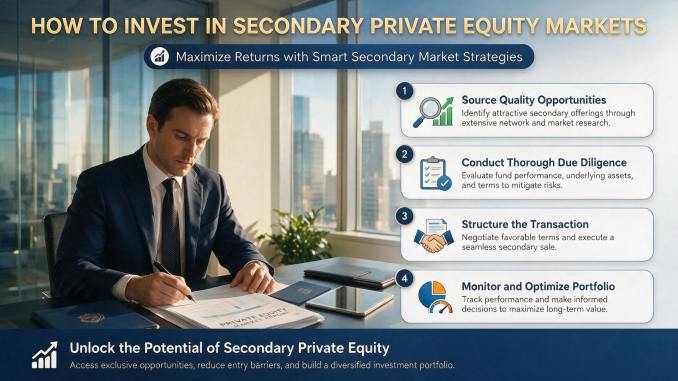
What the Secondary Market Actually Is and Why It Has Grown So Fast
Private equity has always had a liquidity problem. Investors commit capital for seven to ten years, and once the commitment is made, there is no easy way out. That was the trade-off families accepted in exchange for the potential returns. But the market has changed. Today, an investor who wants to exit a private fund commitment early can often sell it on the secondary market, and a family that wants exposure to private equity without the long lock-up can buy into funds that are already mature. That shift has turned the private equity secondary market from a niche corner of the industry into one of its fastest-growing segments.
The growth has been driven by several forces. On the sell side, investors have found themselves over-allocated to private equity after years of strong fundraising, and they need to rebalance. Some have faced liquidity pressures and needed cash. Others have simply changed their strategy and want to exit funds that no longer fit. On the buy side, investors have discovered that secondary purchases can offer attractive returns with less risk than primary commitments, because the underlying companies are already known and the funds are already partly invested. That combination of supply and demand has created a functioning market where there was once only an occasional transaction.
The mechanics are straightforward in concept. A seller transfers its interest in a private equity fund to a buyer, and the buyer assumes the remaining commitment obligations and receives the future distributions. The transaction is typically priced at a discount or premium to the fund’s reported net asset value, depending on market conditions, the quality of the underlying portfolio, and the negotiating leverage of the parties. The fund’s general partner usually has to consent to the transfer, and the buyer has to meet the fund’s eligibility requirements. Those requirements can slow the process, but they also protect the fund and its investors.
For families considering Secondary private equity investments, the appeal is clear. A secondary purchase can provide immediate exposure to a diversified portfolio of companies, shorten the time to liquidity, and capture a discount to net asset value. But the market is not without risks, and the family should understand the mechanics, the pricing, and the due diligence requirements before committing capital. The secondary market rewards investors who do their homework and punishes those who treat it as a shortcut.
The Main Types of Secondary Transactions and What Each One Involves
The most common type of secondary transaction is the sale of a limited partner interest, often called an LP stake. In this transaction, an existing investor sells its entire interest in a fund to a buyer, and the buyer takes over the remaining commitment and the future distributions. LP stake sales are typically priced at a discount to net asset value, with the discount reflecting the illiquidity, the remaining life of the fund, and the quality of the underlying portfolio. The advantage for the buyer is that it gets immediate exposure to a portfolio that has already been assembled, and it avoids the blind pool risk of a primary commitment.
A second type is the direct secondary, which involves the sale of a direct interest in a single company rather than a fund interest. Direct secondaries are often used when a company has been held by a fund for several years and the fund wants to exit before a full sale, or when an early investor wants to sell its stake before an IPO. Direct secondaries can offer attractive returns, but they require more due diligence because the buyer is evaluating a single company rather than a diversified portfolio. The buyer needs to understand the company’s financials, its market position, and its exit prospects, and it needs to be comfortable with the concentration risk.
A third type is the structured secondary, which involves a more complex transaction designed to meet the needs of both the seller and the buyer. Structured secondaries can include preferred equity, deferred payments, or other features that bridge the gap between the seller’s desired price and the buyer’s desired return. These transactions are often used when the seller wants liquidity but does not want to accept a large discount, or when the buyer wants downside protection. They require sophisticated legal and financial advice, and they are typically used by larger investors.
A fourth type is the GP-led secondary, which involves the fund’s general partner leading a transaction to move one or more portfolio companies into a new vehicle. In a GP-led secondary, the existing investors are given the option to sell their interests or roll them into the new vehicle, and new investors are brought in to provide liquidity. GP-led secondaries have become increasingly common, and they can be attractive because they allow the fund to hold a promising company for longer than the original fund life would allow. But they also raise conflicts of interest, because the general partner is on both sides of the transaction, and investors should scrutinize the terms carefully. Private fund liquidity solutions have evolved significantly, and families should understand the full range of options before deciding which one fits their needs.

Pricing, Discounts, and What the Market Is Really Telling You
Secondary transactions are typically priced at a discount to the fund’s reported net asset value, and the size of that discount is one of the most important variables in the transaction. The discount reflects several factors, including the illiquidity of the interest, the remaining life of the fund, the quality of the underlying portfolio, and the current supply and demand in the market. During periods of stress, discounts widen, because sellers are more motivated and buyers have more leverage. During periods of strong demand, discounts narrow, and some high-quality interests may even trade at a premium.
The discount is not a free lunch. A large discount may reflect genuine concerns about the underlying portfolio, such as a concentration in a troubled sector or a company that is underperforming. The buyer should understand why the discount exists before assuming it represents an opportunity. A discount that is driven by market-wide conditions may be attractive, while a discount that is driven by company-specific problems may be a warning sign. The buyer should conduct the same due diligence it would conduct on a primary commitment, and it should pay particular attention to the fund’s valuation policies and its history of write-downs.
The pricing process itself can be complex. Secondary transactions are typically negotiated privately, and the price depends on the negotiating leverage of the parties. A seller that is under pressure to sell may accept a larger discount, while a seller that can afford to wait may hold out for a better price. The buyer should understand the seller’s motivations and should be prepared to walk away if the terms are not attractive. A disciplined buyer sets a target price and does not deviate from it, even if the transaction is presented as a rare opportunity.
Valuation is also a challenge, because private equity interests are not priced by the market every day. The fund’s reported net asset value is based on estimates that may not reflect the true economic value of the underlying companies, especially in a stressed market. The buyer should look at the fund’s valuation policies, its history of write-downs, and the quality of its underlying portfolio. It should also consider the timing of future distributions, because a fund that is close to its exit phase may be worth more than one that is still in its investment period. Private equity transactions in the secondary market require careful analysis, and the buyer should not rely on the reported NAV alone.
Due Diligence and the Risks That Are Easy to Miss
Due diligence on a secondary transaction is similar to due diligence on a primary commitment, but it has some important differences. The buyer is evaluating a portfolio that has already been assembled, so it can look at the actual companies in the fund rather than at the manager’s strategy in the abstract. That is an advantage, because it allows the buyer to assess the quality of the underlying investments directly. But it also means the buyer needs access to detailed information about each company, which can be difficult to obtain.
The buyer should start with the fund’s reported financials, including its net asset value, its cash flows, and its distribution history. It should review the fund’s portfolio company reports, its valuation policies, and its track record of exits. It should also speak with the fund’s general partner, because the GP’s cooperation is often necessary for the transaction to proceed, and the GP’s willingness to provide information is a signal of the fund’s quality. A GP that is reluctant to share information may be hiding problems, and the buyer should be cautious.
The buyer should also consider the fund’s concentration risk. A fund that is heavily concentrated in a single company or a single sector may be more vulnerable to a downturn than one that is diversified. The buyer should look at the fund’s largest holdings, its sector exposure, and its geographic exposure, and it should assess whether those exposures are consistent with its own risk tolerance. A secondary purchase that looks cheap may be cheap for a reason, and the buyer should understand what that reason is before committing capital.
The buyer should also consider the legal and structural aspects of the transaction. The fund’s limited partnership agreement may restrict transfers, require GP consent, or impose other conditions that affect the transaction. The buyer should review the LPA carefully and should work with legal counsel who has experience in secondary transactions. The buyer should also consider the tax implications of the transaction, because the purchase of a fund interest can have different tax consequences than a primary commitment. Secondary fund investing is a specialized area, and the family should work with advisors who understand the nuances.
Building a Secondary Program and Common Mistakes
The families that do well with secondary investing tend to build a program rather than making one-off purchases. A secondary program involves setting a target allocation, identifying the types of transactions that fit the family’s goals, and building relationships with the intermediaries and GPs who source deals. That approach allows the family to see a steady flow of opportunities and to be selective about which ones it pursues, rather than relying on whatever happens to come along.
A secondary program can also provide diversification across vintages, strategies, and managers. By buying interests in funds that were raised in different years, the family can avoid the concentration that comes from committing to a single vintage. By buying interests in different strategies, the family can reduce its exposure to any single sector or approach. And by buying interests managed by different GPs, the family can reduce its dependence on any single manager. That diversification is one of the main advantages of secondary investing, and the family should design its program to capture it.
The most common mistake in secondary investing is overpaying. The secondary market can be competitive, and buyers who are eager to deploy capital may accept prices that do not reflect the underlying risk. A disciplined buyer sets a target return, evaluates each transaction against that target, and walks away if the numbers do not work. That discipline is what separates successful secondary investors from those who end up with a portfolio of underperforming interests.
Another common mistake is underestimating the complexity of the transaction. Secondary transactions involve legal, tax, and operational issues that can be time-consuming and expensive to resolve. The family should be prepared for that complexity and should work with advisors who have experience in the secondary market. A transaction that looks simple on the surface may have hidden complications, and the family should not assume that it can handle the process on its own.
Ultimately, the secondary market is a valuable tool for families that want private equity exposure with more flexibility and potentially less risk than a primary commitment. It can provide immediate diversification, shorten the time to liquidity, and capture discounts to net asset value. But it requires the same discipline, due diligence, and patience that any private equity investment requires, and the families that succeed are the ones that treat it as part of a broader strategy rather than as a shortcut. Those families are the ones that are able to capture the opportunities the secondary market offers while avoiding the pitfalls that catch less careful investors.