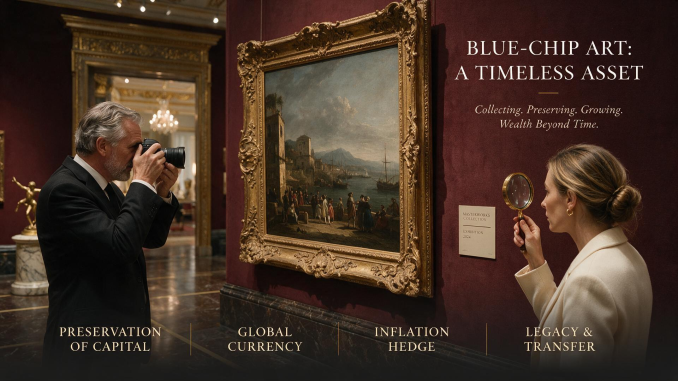
What Makes an Artist Blue Chip and Why It Matters
The term blue chip comes from the stock market, where it refers to large, established companies with a long record of stability and a reputation that does not depend on a single product or a single quarter. The art world borrowed the term because it needed a way to describe artists whose markets behave in a similar way. A blue-chip artist is one who has achieved a level of institutional recognition, market depth, and historical importance that makes their work less volatile than the work of emerging or mid-career artists. The category is not official, and the boundaries are debated, but the concept is useful because it helps collectors understand which artists are likely to hold their value through a downturn and which are not.
The first characteristic of a blue-chip artist is institutional validation. Their work is held in major museum collections, it has been the subject of significant scholarly research, and it appears in the standard art history surveys. That validation creates a permanent base of demand, because museums, foundations, and serious collectors are committed to owning and preserving the work. It also creates a floor under prices, because the work is unlikely to fall out of favor entirely as long as the institutions continue to support it.
The second characteristic is market depth. A blue-chip artist has a large enough body of work and a large enough collector base that the market can absorb sales without collapsing. If a major work comes to auction, there are multiple bidders who are willing to compete for it. If a collector decides to sell, there is a market for the work at a range of price points. That depth is what allows the market to function smoothly, and it is what distinguishes a blue-chip artist from one whose market is thin and easily disrupted by a single sale.
The third characteristic is historical importance. Blue-chip artists are typically those who have played a significant role in the development of art history, whether as innovators, as leaders of a movement, or as influences on subsequent generations. That historical importance gives their work a permanence that is not dependent on fashion, and it makes the work more likely to be studied, exhibited, and collected over time. The fourth characteristic is price stability. Blue-chip artists tend to have less volatile prices than emerging artists, because the demand is broader and the supply is more predictable. That stability is not a guarantee, but it is a meaningful advantage for collectors who are investing for the long term. Blue chip artists are not immune to market cycles, but they tend to recover more quickly and to hold their value more reliably than artists whose markets are less established.
How Blue-Chip Art Markets Actually Work
The blue-chip art market operates through a small number of channels, and understanding them is essential for anyone who wants to invest. The primary channel is the auction houses, particularly Christie’s and Sotheby’s, which handle the majority of high-value sales. The auction process is transparent, in the sense that the results are published, but it is also unpredictable, because the final price depends on the competition among bidders on a given day. A work that is expected to sell for a certain amount may sell for more or less, depending on who shows up and how badly they want it.
The second channel is the dealers, who buy and sell works privately and often represent artists directly. Dealers can offer access to works that are not available at auction, and they can provide expertise and guidance that auction houses cannot. But the dealer market is less transparent, and the markup can be significant. A collector who buys from a dealer may pay a premium for the access and the expertise, and that premium may not be recovered if the work is sold later at auction.
The third channel is the private sale, which involves a transaction between a buyer and a seller without the involvement of an auction house or a dealer. Private sales offer discretion and flexibility, but they also require the buyer to do more due diligence, because there is no intermediary to verify the work’s authenticity or its provenance. The fourth channel is the art fair, which brings together dealers from around the world and allows collectors to see a wide range of works in a single location. Art fairs are an important part of the market, especially for contemporary art, and they can be a good way to discover new artists and to build relationships with dealers.
Each channel has its own economics, and the family should understand them before making a purchase. The auction channel is the most transparent, but it is also the most competitive. The dealer channel is the most relationship-driven, but it is also the most expensive. The private sale channel is the most flexible, but it is also the most risky. High value art market participants typically use a combination of channels, depending on the work and the circumstances, and the family should be prepared to do the same.
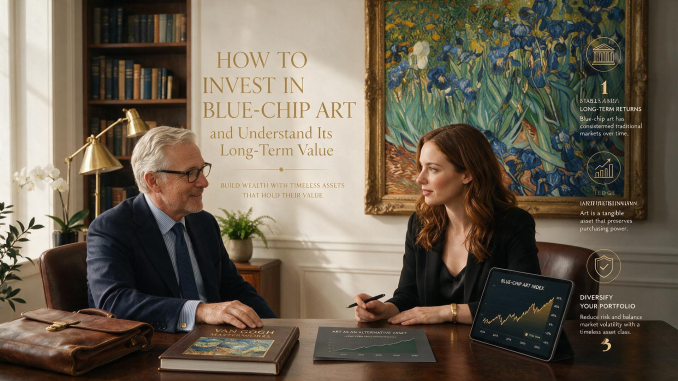
Valuation, Pricing, and the Difficulty of Getting the Number Right
Valuing a work of art is not like valuing a stock or a bond. There is no earnings stream, no dividend, and no maturity date. The value is determined by what a buyer is willing to pay, and that depends on a combination of factors that are difficult to quantify. The auction record for a comparable work is the most common benchmark, but it is not always reliable, because the market changes and the comparable work may not be truly comparable. A work from the same series, the same period, or the same size may sell for a very different price, depending on its condition, its provenance, and its exhibition history.
The appraisal process is the standard way to establish value, and it is typically conducted by a qualified appraiser who has expertise in the artist’s market. The appraiser will consider the work’s condition, its provenance, its exhibition history, its literature references, and the recent auction records for comparable works. The appraisal will produce a value range, not a single number, because the market is not precise enough to support a single figure. The family should understand that the appraisal is an opinion, not a fact, and it should be prepared for the value to change as the market changes. Fine art valuation is an ongoing process, not a one-time event.
The pricing of blue-chip art is also affected by the identity of the seller and the buyer. A work that comes from a prestigious collection may command a premium, because the provenance adds value. A work that is being sold by a collector who is under pressure to sell may sell for a discount, because the buyer knows the seller is motivated. A work that is being sold to a museum may sell for a different price than one that is being sold to a private collector, because the museum may be able to offer tax benefits or other incentives. The family should understand those dynamics before entering the market, because they affect the price the family pays and the price it receives.
The family should also consider the transaction costs. The buyer’s premium at auction can be twenty percent or more, and the seller’s commission can be ten percent or more. Those costs reduce the return on the investment, and they should be factored into the purchase decision. A work that appears to be a bargain at auction may not be a bargain after the premium is added, and a work that appears to be expensive may be a better deal if the premium is lower. The family should calculate the all-in cost, not just the hammer price.
Returns, Risks, and the Case for Patience
The returns on blue-chip art have historically been competitive with other asset classes, but they are not guaranteed, and they can be volatile. The market is driven by a combination of factors, including the global economy, the supply of works, the demand from collectors, and the level of interest rates. During periods of strong economic growth and low interest rates, the art market tends to perform well, because collectors have more capital and more confidence. During periods of economic stress, the market tends to slow, because collectors become more cautious and the supply of works increases as some owners decide to sell.
The risks of blue-chip art investing are significant, and they should be understood before committing capital. The first risk is illiquidity. A work of art can take months or years to sell, and the process is not always predictable. The second risk is authenticity. The art market has a forgery problem, and even experienced collectors have been fooled by sophisticated fakes. The third risk is provenance. A work that has been stolen, looted, or subject to a claim of ownership can be subject to seizure, even if the family bought it in good faith. The fourth risk is market concentration. The blue-chip market is dominated by a small number of artists, and a decline in the market for one of those artists can have a significant impact on a collection. Art investment returns are not guaranteed, and the family should be prepared for the possibility that the work does not appreciate as expected.
The case for patience is strong. The families that have done well with blue-chip art are the ones that have held their works for decades, not months. They have bought what they loved, they have held through market cycles, and they have sold when the timing was right. That approach is not exciting, but it is effective. The families that try to trade art like a stock often find that the transaction costs and the illiquidity erode their returns, and that the market does not move as quickly as they expected.
Building a Collection and Managing the Risks
Building a blue-chip collection requires a clear strategy, a strong network, and a willingness to be patient. The family should start by defining its goals, including whether it wants to collect for pleasure, for investment, or for both. It should then identify the artists and the periods that fit those goals, and it should build relationships with dealers, auction specialists, and other collectors who can provide access and expertise. The family should also consider working with an art advisor, who can help source works, negotiate prices, and manage the collection.
The family should diversify its collection across artists, periods, and mediums, and it should avoid concentrating too heavily in a single artist or a single movement. It should also consider the collection’s role in its broader portfolio, and it should size the allocation appropriately. A collection that is too large may be difficult to manage and to sell, while a collection that is too small may not provide the diversification benefits that art can offer.
The family should also manage the risks through insurance, authentication, and legal review. It should insure the collection for its full value, including the cost of restoration and the loss of market value if the work is damaged. It should verify the authenticity of every work before purchase, and it should work with legal counsel to ensure that the title is clear and that the purchase agreement is properly drafted. It should also maintain records of the collection, including the provenance, the condition, and the exhibition history, because those records are essential for valuation and for resale. Blue chip art investment is not a passive activity. It requires ongoing attention, and the families that succeed are the ones that treat it as a serious part of their wealth strategy.
Common Mistakes and the Long View
The most common mistake is buying on emotion. A family that falls in love with a work may overlook its flaws, overpay for it, and fail to consider its resale potential. The result can be a collection that is a source of pleasure but not a source of wealth. The family should approach the purchase with discipline, and it should be prepared to walk away if the work does not meet its criteria.
Another common mistake is failing to do the due diligence. A family that buys a work without verifying its authenticity, its provenance, and its condition may find that it has bought a liability rather than an asset. The cost of due diligence is small relative to the value of the work, and the consequences of skipping it can be severe.
A third mistake is ignoring the costs of ownership. The purchase price is only the beginning. The family should budget for insurance, storage, conservation, and estate planning, and it should factor those costs into the investment analysis. A collection that looks affordable on paper may be a financial drain in practice, especially if the family does not have the resources to maintain it properly.
Ultimately, blue-chip art can be a valuable part of a diversified portfolio, but it requires patience, expertise, and discipline. The families that do well are the ones that collect what they love, that understand the market, that do their due diligence, and that plan for the long term. Those families tend to find that the collection is both a source of joy and a source of wealth, and that the two are not in conflict. The families that treat art as a quick investment often find that the costs outweigh the benefits. The difference is in the approach, and the approach is what makes the collection valuable.