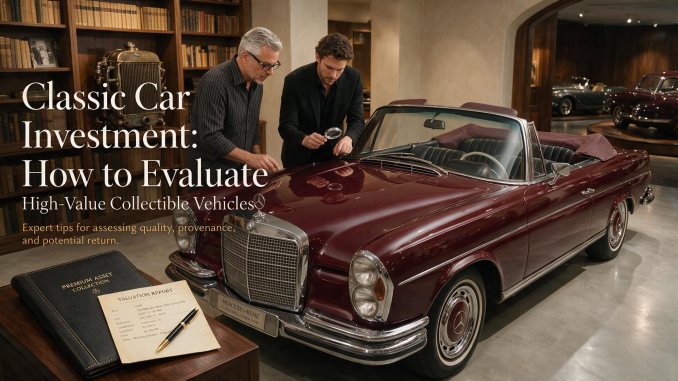
Why Classic Cars Reward Knowledge More Than Capital
Classic cars occupy a peculiar place in the world of collectibles. They are machines, which means they can be driven, enjoyed, and experienced in a way that a painting or a watch cannot. They are also industrial objects, which means their value is tied to engineering, design, and history in ways that are different from other collectibles. And they are expensive to own and maintain, which means the families who succeed with them tend to be the ones who understand the costs before they buy. The result is a market where knowledge matters more than capital, and where a buyer who knows the difference between a well-documented example and a questionable one can capture significant value.
The market itself has matured dramatically over the past two decades. What was once a hobby for enthusiasts has become a global asset class, with specialist auction houses, dedicated indices, and institutional investors. The top of the market, where cars sell for eight figures, is dominated by a small number of models with exceptional provenance, and the competition for those cars is fierce. The middle of the market, where most transactions occur, is more accessible but also more variable, and the difference between a good buy and a bad one often comes down to the details.
The financial case for classic cars rests on scarcity and demand. A car that was produced in limited numbers, that has a significant racing history, or that represents a milestone in automotive design is unlikely to be replicated. As wealth grows globally and as the pool of collectors expands, the demand for those cars can increase faster than the supply, which supports prices over time. That dynamic has produced impressive returns in some segments, and it has attracted investors who see classic cars as a store of value that is uncorrelated with public markets.
But the financial case has limits, and the family should understand them before committing capital. Classic cars are illiquid, and the market for any single car can be thin. The transaction costs are significant, often ten percent or more between buyer’s premium and seller’s commission. The costs of ownership, including storage, maintenance, insurance, and restoration, can be substantial. And the value of a car depends heavily on its provenance, its condition, and its originality, all of which require specialized expertise to evaluate. A family that treats classic cars as a simple store of value may find that the costs and the risks outweigh the returns. Classic car investment works best when the family is clear about its goals and prepared for the costs.
The Categories and the Cars That Have Outperformed
The classic car market is not a single market. It is a collection of segments, each with its own buyer pool, its own price drivers, and its own risks. The most established segment is the post-war European sports car, including models from Ferrari, Porsche, Mercedes-Benz, and Jaguar. Cars like the Ferrari 250 GTO, the Porsche 911 Carrera RS, and the Mercedes-Benz 300 SL have become icons, and their values have appreciated dramatically over the past two decades. Those cars are rare, they have a strong racing heritage, and they are widely recognized as design masterpieces, which makes them attractive to collectors around the world.
American muscle cars are another important segment, and they have a different appeal. Cars like the Shelby Cobra, the Chevrolet Corvette, and the Ford Mustang have a strong cultural following, and they are more accessible than the European icons. The market for those cars is driven by nostalgia, by design, and by rarity, and it has produced strong returns for well-chosen examples. But the market is also more variable, and the difference between a top example and an average one can be significant.
Pre-war cars are a third segment, and they appeal to a different type of collector. Cars from the 1920s and 1930s, such as the Duesenberg, the Bugatti, and the Rolls-Royce, are valued for their craftsmanship, their rarity, and their historical significance. The market for those cars is smaller and more specialized, and it tends to be driven by a small group of dedicated collectors. The returns can be strong, but the liquidity is limited, and the family should be prepared for the possibility that a car may take time to sell.
Modern collectibles are a fourth segment, and they include cars from the 1980s and 1990s that have recently become desirable. Cars like the Porsche 959, the Ferrari F40, and the BMW E30 M3 have seen significant appreciation as collectors who grew up admiring them have reached the age and wealth to buy them. The market for those cars is younger and more dynamic, and it can be more volatile than the market for older cars. The family should understand the dynamics of the segment before making a purchase. Luxury car investment requires an understanding of which segment the car belongs to and how that segment is likely to perform.
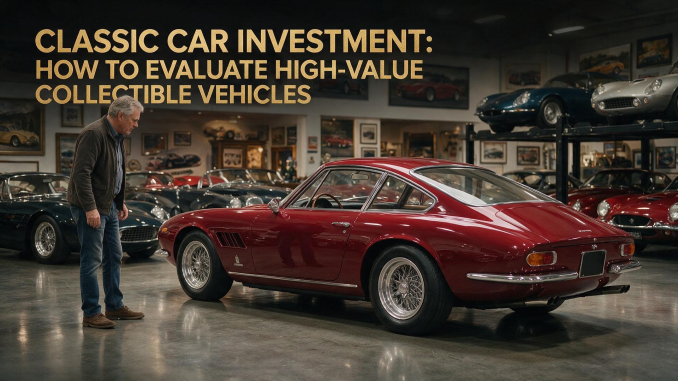
Condition, Provenance, and the Factors That Drive Value
The value of a classic car is determined by a combination of factors, and the family should understand each of them before making a purchase. The first factor is originality. A car that retains its original engine, transmission, paint, and interior is worth far more than one that has been restored or modified. The term matching numbers refers to a car whose engine and chassis numbers correspond to the factory records, and it is one of the most important indicators of originality. A car with matching numbers is more desirable to collectors, and it is more likely to hold its value over time.
The second factor is condition. A car that is in excellent condition, whether original or restored, is worth more than one that is worn or damaged. The quality of a restoration matters enormously, and a car that has been restored to a high standard can be worth as much as an original example. The family should commission a thorough inspection by a marque specialist, and it should review the restoration records if they are available. A car that has been restored poorly may be worth less than an unrestored example, because the cost of correcting the work can be substantial.
The third factor is provenance. A car that has a documented history, especially one that includes a famous owner, a racing career, or a significant event, is more valuable than one with a thin or unknown history. The provenance should be supported by documentation, including the original title, the service records, and any photographs or correspondence. A car with a well-documented history is more desirable to collectors, and it is more likely to sell quickly when the family wants to exit. Collectible car valuation depends heavily on provenance, because the history is what makes a car unique.
The fourth factor is rarity. A car that was produced in limited numbers, or that is one of a kind, is more valuable than one that was mass-produced. Rarity can come from the production run, from a special edition, or from a unique feature. The family should understand the production numbers and the rarity of the car before making a purchase, and it should be wary of any car that is described as rare without evidence. The fifth factor is documentation. A car that comes with its original manuals, tools, and paperwork is worth more than one that does not, because the documentation confirms the car’s authenticity and its history.
Costs, Storage, and the Practicalities of Ownership
Classic cars are not passive assets. They require storage, maintenance, insurance, and restoration, and the costs can be substantial. A car that is stored in a climate-controlled garage needs a secure facility, and the cost of that facility can be significant. A car that is driven regularly needs maintenance, including oil changes, tune-ups, and tire replacement, and the cost of those services can be higher than for a modern car. A car that is restored needs a specialist shop, and the cost of a full restoration can exceed the value of the car. The family should budget for those costs, and it should factor them into the investment analysis.
The insurance requirements are particularly important. A classic car policy should cover the full value of the car, including the cost of restoration and the loss of market value if the car is damaged. It should also cover the car while it is in transit, on loan, or in storage. The family should work with an insurance advisor who specializes in classic cars, and it should review the policy annually to ensure that the coverage is adequate. A policy that is based on an outdated appraisal may leave the family underinsured, which means it may not be able to recover the full value of the car if it is damaged or stolen.
The maintenance requirements vary by car. A pre-war car may need more frequent servicing than a post-war car, and a high-performance car may need more specialized care than a touring car. The family should understand the maintenance requirements before making a purchase, and it should be prepared for the costs and the time commitment involved. A car that is not properly maintained may lose value, and the cost of correcting the neglect can be substantial. Classic car market trends can change quickly, and the family should have the information it needs to respond to those changes.
The family should also consider the storage requirements. A classic car needs a garage that is secure, climate-controlled, and protected from the elements. The garage should be equipped with a battery tender, a car cover, and a fire suppression system, and it should be inspected regularly to ensure that it is in good condition. A car that is stored improperly may deteriorate, and the cost of correcting the damage can be significant.
Buying, Selling, and the Exit Strategy
The buying process is different from the selling process, and the family should understand both before committing capital. Buying at auction is the most transparent channel, because the results are published and the competition is visible. But the buyer’s premium adds to the cost, and the competition can be fierce. Buying from a dealer offers access and expertise, but the markup can be significant and the transparency is limited. Buying from a private seller offers discretion, but the due diligence burden falls entirely on the buyer. The family should choose the channel that fits its goals and its resources, and it should work with advisors who have experience in that channel.
The selling process is equally important, and it should be considered before the purchase. A family that plans to sell in a few years should consider the transaction costs, the market liquidity, and the tax consequences. A family that plans to hold for decades should consider the long-term trends in the market and the car’s place in it. The exit strategy affects the return calculation, and it should be considered before the purchase. A car that is easy to sell is more valuable than one that is difficult to sell, even if the purchase price is the same.
The family should also consider the tax consequences. A car that is sold at a gain may be subject to a higher tax rate than a stock or a bond, because collectibles are taxed at a maximum rate that is higher than the long-term capital gains rate. A car that is held until death may receive a step-up in basis, which eliminates the capital gain for heirs, but it may also be subject to estate tax. The family should work with a tax advisor who understands the rules for collectibles, and it should plan for the tax consequences before making a purchase. Rare automobile investing should be part of a broader estate plan, not a standalone decision.
Common Mistakes and the Long View
The most common mistake is buying on emotion. A family that falls in love with a car may overlook its flaws, overpay for it, and fail to consider its resale potential. The result can be a collection that is a source of pleasure but not a source of wealth. The family should approach the purchase with discipline, and it should be prepared to walk away if the car does not meet its criteria.
Another common mistake is failing to do the due diligence. A family that buys a car without verifying its originality, its condition, and its provenance may find that it has bought a liability rather than an asset. The cost of due diligence is small relative to the value of the car, and the consequences of skipping it can be severe.
A third mistake is underestimating the costs. Classic cars require storage, maintenance, insurance, and restoration, and those costs can be significant. The family should budget for those costs, and it should factor them into the investment analysis. A car that looks affordable on paper may be a financial drain in practice, especially if the family does not have the resources to maintain it properly.
Ultimately, classic cars can be a valuable part of a diversified wealth plan, but they require passion, expertise, and discipline. The families that do well are the ones that collect what they love, that understand the market, that do their due diligence, and that plan for the long term. Those families tend to find that the collection is both a source of joy and a source of wealth, and that the two are not in conflict. The families that treat classic cars as a quick investment often find that the costs outweigh the benefits. The difference is in the approach, and the approach is what makes the collection valuable.